WELCOME TO THE BERKSHIRE SWEET GOLD MAPLE FARM!
A family farm in Heath, Massachusetts, run by Janis Steele & Brooks McCutchen and their children, Connor, Rowan and Gavin, and extended family, Leighton and Martha McCutchen.   Call toll free to the farm any day 1-888-576-2753 


FROM THE HIGHLAND FORESTS OF THE BERKSHIRES !

Our family farm crafts premium Single-Crop, Single-Batch maple syrups handmade exclusively from our own harvest.  A bottle of Berkshire Sweet Gold  samples a single Spring day's 15 gallon barrel of pure maple syrup made in about an hour from sap collected from 5,500 Sugar Maple and Red Maple trees in our highland woods.

What happens in a maple forest harvest?
       In the forest...
       ...as late winter temperatures climb above freezing, starches stored in maple roots convert to sugars which can flow in the mineral-rich sap to feed Spring leaf buds.  A unique property of North American maple trees makes it possible to collect this fluid which is often around 2%minerals and sugars: air cells present in the hardwood (xylem) compress and expand during the Spring pattern of freezing and thawing so that on a warm day the sap, under significant pressure (up to 40psi at the trunk base), drips rapidly from small holes drilled at the beginning of the harvest.  As trees prepare to bud over the next 6-8 weeks, a wild forest fermentation takes place.  Dozens of changing airborne bacteria and yeast strains interact with the sap as it leaves the trees through our lines and comes to our syrup house, producing different sugars, amino acids and proteins.  These forest fermentation processes accelerate with warming temperatures and passing days, and -- along with other natural elements like soil composition, maple tree varietals, and weather patterns-- establish the wild forest flavors
that form the basis for maple's variance.

        In the Sugarhouse...
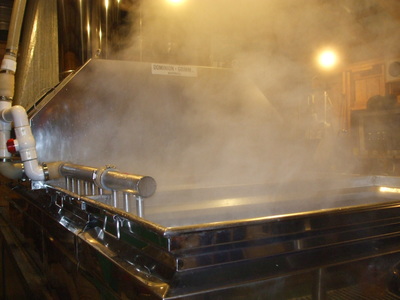
       ...here our farm craft comes into play.  With the use of traditional practices and state-of-the-art technology, we bring the sap to 87% sugars and minerals.  At the beginning of the harvest, it takes roughly 30 gallons of sap to make 1 gallon of syrup.  By the end of the harvest, this ratio can climb over 100 to 1.  Using high-pressure filtration and evaporation, we turn the sap to syrup.  In roughly one hour's time  we will fill a 15 gallon barrel with syrup, capturing that hour's growing wild forest flavors. This is what we mean by Single-Batch from a Single-Crop . For more on maple sap harvesting, biochemistry and processing into syrups see the North American Maple Syrup Producers Manual, 2nd Edition, (2006, Ohio State University Extension.)

       By contrast, many farmers blend syrups of varying colors, produced over many hours or days, for convenience or for market uniformity.  Large packagers further blend syrups from different farms in mass processing. For example, the Quebec maple federation purchases and centralizes the majority of its 7,400 member farms' harvest for later redistribution.  Syrups blended from different time periods, barrels or farms (as in creating a Medium amber by mixing Light and Dark syrups) may be far less smooth and sophisticated in flavor and can develop cloying aftertastes that may limit a syrup's versatility.  Our perspective is that over the last fifty years, the public's increasingly narrow association of maple syrup with heavy breakfast foods has occurred in concert with the dominance of wholesale-commodity harvesting and marketing practices like blending. The unique and traditional qualities of each farm’s syrups, each hour’s shifting flavors and thus each color’s many facets, will not survive a blending process.  

A role for Family Scale Farms   
    Family scale farms can have an important role in supporting a healthy food supply for the public by upholding the flavor variance in a crop that larger, wholesale-driven farms typically must sacrifice for market demands of uniformity.  Family farms that focus on such variance can root themselves in agricultural land conservation, attention to biodiversity, concern for organic methods, a pastoral landscape open to public interaction, and fair wages for the family farmer.  At Berkshire Sweet Gold Maple Farm we work to bring all these interests together into a fine agricultural harvest that may nourish your aesthetic experiences of food, table, and community, as family scale farm foods have done for centuries.  Please explore and discover the many pleasures and healthy uses that come from Single-Crop, Single-Batch maple syrups in all their rich variance.  Learn more about our farm on this website or come visit us in Heath. 

Tasting Notes
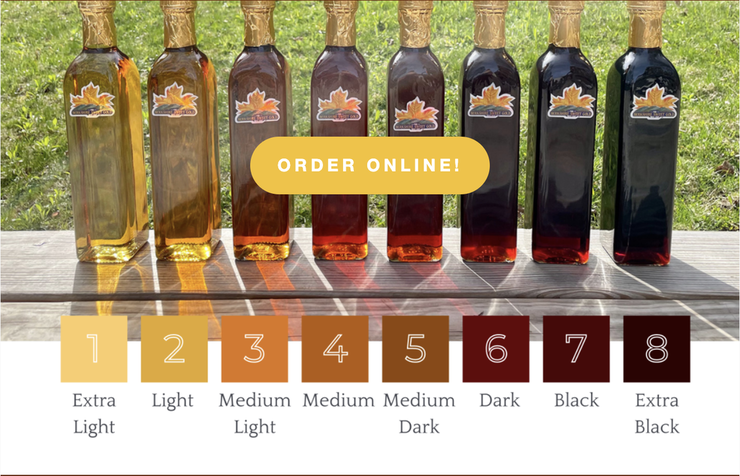
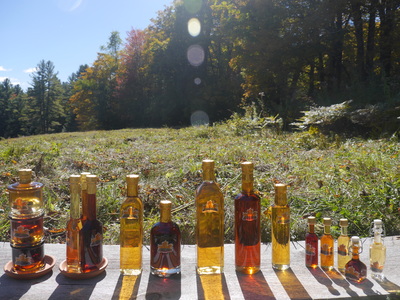
       The syrups we craft from our wild forest sap begin with Light golden ambers distinguished by striking confectionery tastes  and smooth, complex finish flavors often of vanillin, nut or white chocolate.  These are followed by Medium ambers' rich, buttery, caramel tones, and then garnet Dark ambers with their robust, sometimes cinnamon or fruity character.  Finally, the warmest
Spring days of April bring us stout, earthy, full-bodied Black Amber   (also called   B )syrups which maintain clean yet long and varied finishes, sometimes with a bit of a bite. It is important to note that in this wild woods harvesting, each of these four color categories (Light-- also called Fancy-- Medium, Dark & Black Amber) in fact house a continuum of colors/ flavors. For example, some Mediums are almost Light in character and some are almost Dark. It is this variance that our farm works to capture: no two batches of Berkshire Sweet Gold’s Single-Crop, Single-Batch ambers are identical, even when the colors are similar. So, don’t pick one favorite!

Syrup in your kitchen
Maple syrup is likely the only food in your kitchen harvested from the woods in a centuries-old tradition. Maple harvesting is a 400 year farming practice first learned from Native Americans who harvested in large quantities and was a first agricultural practice for many early settlers to the Northeast as they cleared land for other crops. Historically, maple was not simply a topping for heavy breakfasts; rather, it was a prized, broad-ranging condiment and garnish for meats, vegetables, fruits, breads and drinks and was complementing many sour and savory spices.  In addition, it was an important new way to preserve foods as an alternative to salting, drying and fermenting.  Maple syrups came into the colonial and European diet around the same time as sugar and from the very beginning was a successfull competitor.  For more on maple's history see Helen and Scott Nearings, The Maple Sugar Book, 1950
(available through Chelsea  Green Publishing 2000, 800-639-4099).

  Berkshire Sweet Gold's  Single-Crop, Single-Batch syrups have clean up-front tastes and open finishes which nicely balance either subtle or robust spicy, sour, savory, salty, or sweet flavors. Dark syrups are certainly not the only cooking syrups and lighter syrups are not higher in quality than a well-made dark syrup. Recipe brochures are available with purchases and new recipes are here on-line.  Send us your favorites The golden fluid contains natural minerals (calcium, potassium, magnesium), proteins, amino acids and trace vitamins (such as Niacin, B5, B2) at 80 calories per ounce (120 for corn syrup, 96 for sugar-dry weight, 90 for honey).

Website last udated April 14,  2009

BERKSHIRE SWEET GOLD MAPLE FARM GOES SOLAR!


This winter a 9.3 KW photovoltaic system has been installed at the farm.  The panels should generate in excess of 80% of the farm's electricity demands.  This project involves the support of three state and federal energy and agricultural grants.  Click the Energy button for more on energy conservation and energy generation at Berkshire Sweet Gold.
 

OUR SYRUPS &
HOW TO ORDER
THEM

Harvest Report,
Direct Market Schedule & Visits

RECIPES!

FARMKID ART
GREETING CARDS & FARM PICTURES